
Oriental-style brass jug, 18th century

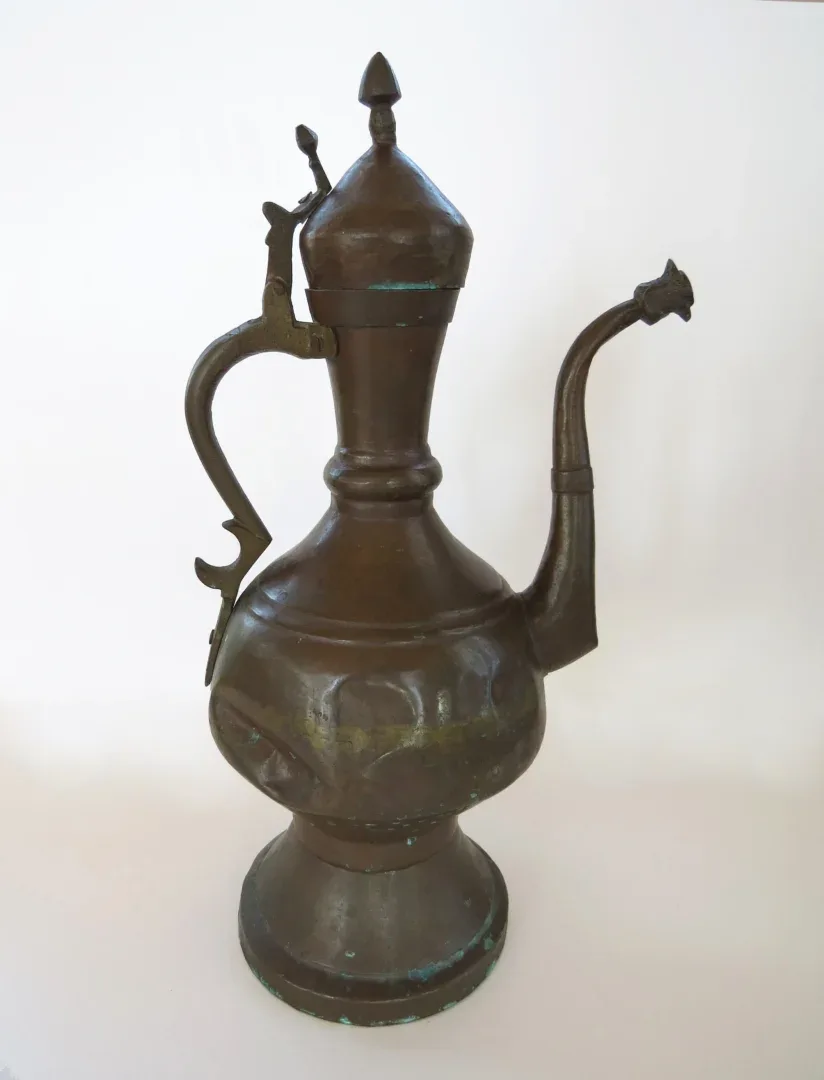
Oriental-style brass jug, 18th century
Heritage
This Oriental-style brass jug is an ethnographic artifact intended for household use, classified as a traditional metal container with domestic and possibly ceremonial functions. The object, dated to the 18th century and attributed to an unspecified region of Eastern origin, is notable for its brass construction—a material frequently used in preindustrial crafts due to its durability, thermal conductivity, and decorative potential.
It is a form specific to Eastern styles, characterized by a rounded body, an elongated neck, and a narrow opening—elements that suggest both a function for storing and pouring liquids and an adaptation to ritual requirements or the transport of water. The side handle and balanced proportions indicate a careful ergonomic design, typical of objects intended for everyday use in traditional households.
The decor features ornamental elements that reflect the influences of Eastern decorative art, in which utilitarian objects are transformed into vessels of cultural and identity-related significance.
The artifact with inventory number FB-3996, OB-681 is relevant to the study of the circulation of metallurgical forms and technologies between the Eastern and Eastern European regions, highlighting processes of cultural transfer during the premodern period. The jug thus serves as a material testament to commercial and cultural interactions, illustrating the connections between artisanal production centers and the traditional households in which such objects were integrated. The object holds documentary and educational value, contributing to the reconstruction of consumption practices and daily rituals related to the use of water in traditional settings. At the same time, it supports the museum’s narrative regarding the diversity of ethnographic heritage and the complexity of cultural influences that shaped the historical landscape of Chișinău during that period.

